Not long ago, finding a hidden water leak meant one thing: destruction. Walls were opened, floors were lifted, gardens were excavated, and driveways were cut — all in the hope of locating a pipe that had failed somewhere out of sight. For property owners, this meant significant additional repair costs, prolonged disruption, and no guarantee that the invasive approach would even find the leak on the first attempt.
Today, the field of leak detection has been transformed by technology. Non-invasive methods now allow qualified specialists to pinpoint leaks in walls, under slabs, and deep underground with extraordinary precision — and in most cases, without any need to open up your property at all. Understanding how these technologies work gives property owners confidence in the process and helps explain why professional detection is always the first step before any repair work begins.
Acoustic Leak Detection: Listening to What Your Pipes Are Saying
Acoustic leak detection is one of the most widely used and proven techniques in the professional find leak detection toolkit. It works on a simple principle: when pressurised water escapes through a crack, hole, or failed joint, it produces a distinct sound — a hiss, rush, or vibration — that travels through the surrounding soil, concrete, or building materials.
Specialist acoustic listening devices amplify these sounds far beyond the range of the human ear. Ground microphones and listening sticks can be placed directly on surfaces — pavement, floor tiles, or soil — to detect the acoustic signature of a leak beneath. Correlator devices go even further: sensors are placed at two points on the pipe, and a computer algorithm analyses the difference in sound arrival times to calculate the precise location of the leak. This method is highly effective for underground supply lines and can locate a leak to within centimetres.
Thermal Imaging: Seeing the Invisible with Infrared
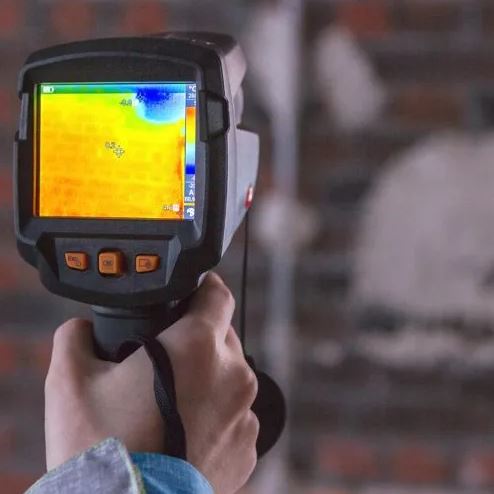
Thermal imaging cameras detect infrared radiation — essentially, heat — and produce colour-mapped images that reveal temperature variations invisible to the naked eye. In leak detection, this technology is invaluable for locating leaks in hot water pipes, underfloor heating systems, and any situation where water at a different temperature from its surroundings is accumulating in building materials.
A leaking hot water pipe within a wall or beneath a floor will warm the surrounding materials. The thermal camera captures this temperature gradient as a vivid contrast against the surrounding area, pointing directly to the leak's location. Cold-water leaks can also be detected, as the evaporation of water cools the surface above — producing a cool signature that stands out clearly against the ambient temperature of dry materials.
Thermal imaging is fast, requires no contact with the surface, and can survey large areas quickly — making it ideal for commercial water leak detection across extensive floor plates or multi-storey buildings. It is often used in combination with other methods to confirm and triangulate findings.
Tracer Gas: The Gold Standard for Underground and Slab Leaks
For underground leaks or those buried within a concrete slab, tracer gas is often the most reliable method available. The process involves isolating the affected pipe section and introducing a carefully controlled mixture of inert nitrogen gas and a small percentage of hydrogen — a combination that is completely harmless, non-toxic, and non-flammable.
The gas is lighter than air and travels upward through soil, concrete, or other materials to emerge at the surface at the point of the leak. A highly sensitive electronic sensor is then passed slowly over the surface of the ground or slab, detecting the hydrogen at parts-per-million concentrations. When the sensor registers the gas, the technician marks the location — giving the plumber an exact excavation point rather than a large search area.
Tracer gas find leak detection is particularly valuable for locating leaks in irrigated gardens, driveways, and footpaths where acoustic signals can be difficult to isolate due to surface noise and variable soil conditions.
CCTV Pipe Inspection: Looking Inside Your Plumbing
Where the condition of the pipe itself is in question, CCTV pipe inspection cameras provide a direct visual assessment. A small, high-resolution camera mounted on a flexible cable is inserted into the pipe through an access point. As the camera travels through the pipe, it transmits live footage to a monitor, allowing the technician to observe the internal condition in real time.
CCTV inspection can identify corrosion, scale buildup, root intrusion, collapsed sections, displaced joints, and cracks with complete clarity. This method is commonly used in drainage systems, stormwater pipes, and sewer lines where blockages and structural failures often coexist with leak points. A recorded inspection report provides a permanent visual record of the pipe's condition — invaluable for insurance claims, property purchase assessments, and maintenance planning.
If you're dealing with a suspected water leak and want fast, accurate, and non-destructive diagnosis, accessing professional leak detection services near me is the most effective path to resolution.
Moisture Meters and Hygrometers: Mapping the Damage
Once the leak source has been located, moisture meters and hygrometers are used to map the extent of water damage in surrounding materials. Moisture meters measure the electrical conductivity or dielectric properties of materials — properties that change significantly when water is present. By taking readings at multiple points across walls, floors, and ceilings, technicians can produce a detailed moisture map that guides remediation efforts.
This information is critical for restoration contractors, who need to know exactly which materials are wet and to what depth, in order to deploy drying equipment effectively and avoid leaving residual moisture that could fuel mould growth.
Why Technology Alone Isn't Enough — Expertise Matters
Access to advanced equipment is only half the equation. Interpreting the data these tools produce — and combining multiple methods to build an accurate, complete picture of a leak's location and extent — requires skill, experience, and professional judgement. Different leak types, building materials, pipe materials, and environmental conditions all influence which techniques are most appropriate and how results should be interpreted.
An experienced find leak detection technician knows how to differentiate between a genuine acoustic signal and surface noise interference, how to account for the influence of structural elements on thermal images, and when to switch between methods for the best outcome. This expertise is what separates a definitive leak location report from an inconclusive investigation.
Technology and Expertise — Together in One Team
Modern leak detection technology has made it possible to solve problems that would once have required significant destruction and expense — but only when it's operated by qualified professionals who know how to deploy it correctly and interpret its results accurately. Whether you're dealing with a suspected slab leak, a rising water bill, or visible water damage with no obvious cause, the answer lies in professional detection before any repair work begins.
Vic Leak Detection brings together the most advanced non-invasive leak detection technology and a highly experienced team of specialists to serve residential and commercial clients across Melbourne and Victoria. From acoustic detection and thermal imaging to tracer gas and CCTV inspection, Vic Leak Detection has the tools and the expertise to find any leak — quickly, precisely, and without unnecessary disruption. Reach out today to book a professional assessment and let technology do the work.
Visit this link for another blog - Residential Water Leak Detection